SARAH  McRAE  MORTON   a fine painter
2010 "The Marrow of Tradition" Paintings from 2009 The Bear in the Mint The Studio Practice The House Call to the Hoovers The Allgyers Of Kings and Fishers Enos and the Star Banks and Smith The Homestead The Procession The Crossing The Field Colors Two by Sea Kollowitz's Girl Red Bird The Best of all Colors Want The Martyr and the Mirror Jessie and Child The Still Labor The Course The Eye of the Storm The Hunt Croquet The Blue Inside the Carriage The Last Judgement Annual Self Portrait 2008 Forging Ahead Blue Brass Post and Beam Horses Descending The Animal Years The Company God sees doG Virtue The Table is Set for Mahler The Deep End of the Yard from the Studio The Arbor and Mitchell's Book The Climbing Rose The 2006 Annual Self Portrait Of Millers and Magicians Kaiser Wilhem Memorial In the Vaults The Mine Collapse Iron Horse Tracks House Fire The Mothers- Reading Over The Daughters - Coral The Mothers - Lace Making The Daughters- Turquoise The Mothers- Arrangement in Black and Green The Daughters - Sky Blue The Mothers- Arrangement in Black and Blue The Daughters - Nested Star The Mothers - Arrangement in Royal Blue The Viewing William Carlos Williams' Blue Green
Sarah McRae Morton's current body of work will be on display at the Red Raven Art Company in Lancaster, PA February 5 - 27. Preview pieces from the show in the 2010 folder of the portfolio. Below is an essay written by the the artist about the work.

"The Marrow of Tradition"


The Title

The title of this exhibition is borrowed from a book written by Charles Chesnutt, first published in 1901. The Marrow of Tradition is considered one of the most accurate literary depictions of the post-bellum south. This novel was one of the first to exemplify how mass media could be used explicitly as a propaganda tool. The novel was written to contradict many sensationalized and biased newspaper accounts deliberately misinforming the public about the massacre during the North Carolina “race riot” of 1898. This book was disturbing and inspiring to me. This show is about perspective and how my biography shapes paintings about my own time. It made me question the truthfulness of my work and think about the impact art can have on the course of history.

About these paintings

I referenced mostly women artists for this series to recognize the work that generations of women have done to make sure women in my place and time can exhibit paintings.
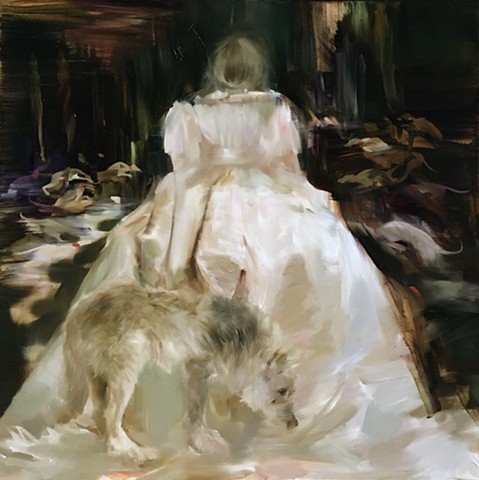
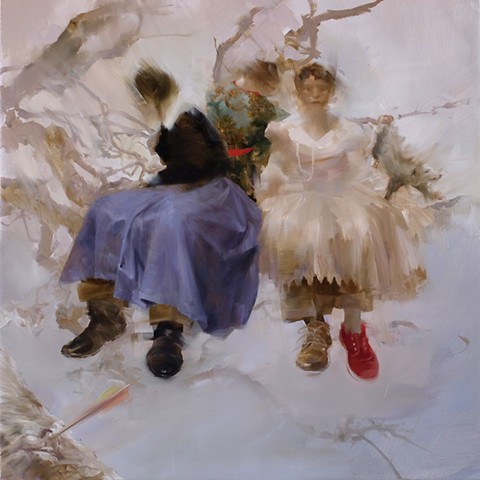
The imagery in this show was inspired by fairytales; especially the macabre stories that are meant to instill the virtue of beauty. The rabbit motif symbolizes femininity and luck. The paintings in this show are designed by re-contextualizing images from historical and contemporary art. Symbols are given new meanings by this rearrangement. I copied vignettes of paintings by Anne Vallayer- Coster, court painter to Marie Antoinette. I learned how to manipulate paint to fur from Rosa Bonheur, a 19th century animaliere. She obtained a permit form the French government to wear pants while she worked, thanks to women like her, I don’t have to consider what I wear to the studio. I used contemporary images from high fashion portfolios, and the18th century wardrobe of Marie Antoinette

How and Why
A wild dog, half coyote, bore her pinkend teeth as I approached. She cradled the hind leg of a Jackrabbit in her jaws. My first thoughts were of Gericault, the Romantic painter who, during the French revolution, painted dismembered corpses in his studio to make more accurate portrayals of war. Then I recognized the severed rabbit foot as an emblem of luck, I was reminded of my own good fortune.
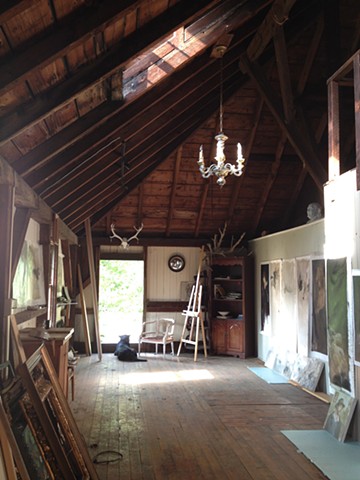
I traveled to New Mexico last year to study two women artists. I wanted to see the landscapes so romanticized through paintings by Georgia O’Keefe. Another contemporary artist, Harmony Hammond, whose work has shaped my career lives there too. Both women were pioneers of the feminist art movement, and I wanted to visit their desert studios. So, I left my studio in Lancaster PA, where I have painted since I was a 10.
By venturing west into the unfamiliar, I pursued a state of mind uncluttered by my former artwork, belongings, and habits. I sought to remove my personal narrative from the ensuing body of work in exchange for more far-reaching issues. I wanted to present facts and approach subjects nonobjectively. Subjects inspiring to me, like the French revolution, Native American History, and the fact that of the first 1,000 solo exhibitions currated at the Museum of Modern Art (MOMA), only five were by women. I feel that my role in society as an artist is to tell these stories.

The truth is that my artwork is inseparable from my thoughts and experiences. I can only paint about injustice, and disaster through my unique lens. I strive to make art as potent, visceral and virtuous as the German artist Kathe Kollwitz did during the World Wars. Since history is subjected to the experience of the person recording it, the source matters. I acknowledge my perspective as a 21century American, white, young, woman of an educated class. I feel that this fortune comes with a responsibility. I have been educated by my parents as well as by institutions. I have inherited and embody the cultural heritage of white southern society. My artistic technical training is of the Western tradition, but unique to my time in this academic lineage is the availability of images from around the world, from thousands of years of people practicing art. I believe if an artist desires to be authentic, the artist must have the integrity to make art revealing their every advantage or limitation.
I have been reluctant to participate in shows of “women artists”. I am an artist. I want my work to be recognized for merit. I realize that there are sins of omission in the cannon of written art history from Vasari to Jansen, but I look forward thinking about the work I can contribute during my lifetime….
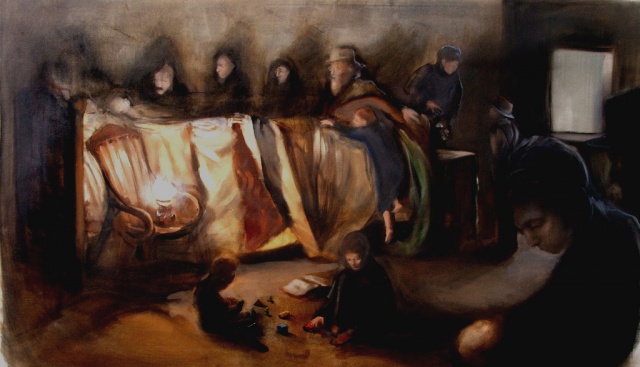
I lived in WV in 2007, an attempt to ethnographically approach the subject of coal mining communities. I intended to, like a journalist, bring attention to the havoc that mining wreaks on the environment and the people who do dangerous work out of desperation. I realized when I walked into a room of male miners, even though my hands are stained with paint, I was seen first of all as a woman, not a painter. The men were intrigued enough to inquire about why I was there. In conversing with people I recognized a recurring sentiment,” if you have the luxury of time to paint, why do you choose to be here?” I was received as a voyeur, but I collected genuine stories. The resulting body of work was about my impression of the place and people.

This current body of work entitled, “The Marrow of Tradition” is my impression of the place I was working, people I met and books I read. There are metaphors encrypted within the paintings, the meanings of which depend on the lens of the viewer. The work has undercurrents about the French revolution, twisted fairy tales, oppression of people in United States history, and the feminist art movement but the paintings are all self-portraits.